


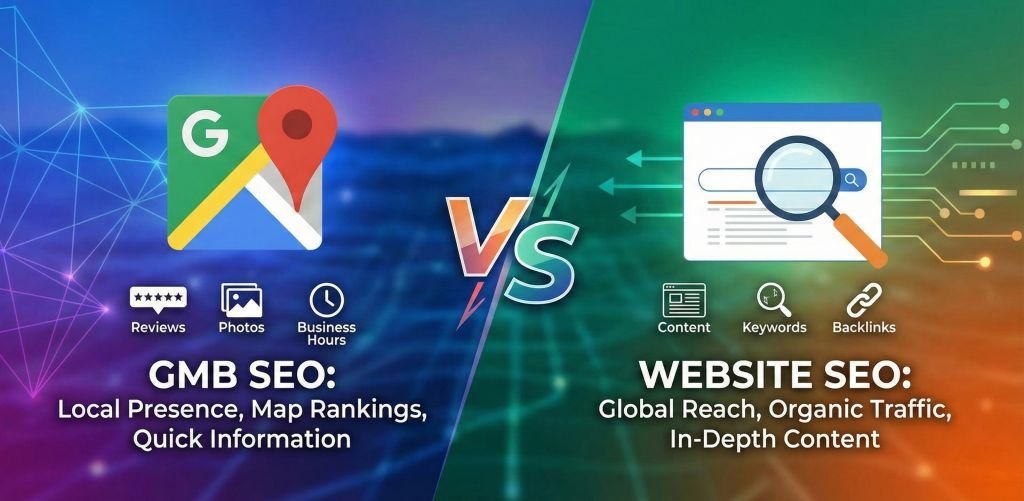
In the battle for local dominance, business owners often face a dilemma: “Do I need a website if I have GMB?” or “Should I focus on Google Maps marketing vs SEO?”
In 2026, the answer isn’t black and white. The digital landscape has evolved into a “Zero-Click” world where Google Business Profile (GMB) often provides the answer before a user ever clicks a link. However, your website remains the ultimate authority engine that builds trust and closes high-ticket deals.
At YoGrow Solutions Pvt Ltd, we’ve analyzed thousands of campaigns. The data is clear: relying on just one is a mistake. Here is the definitive guide to GMB SEO vs Website SEO and what actually drives leads today.
To understand the difference between local SEO and website SEO, you must look at user intent.
Primary Goal: Fast answers and immediate action.
Ranking: Focuses on the “Local 3-Pack” (Maps results).
User Intent: “I need a plumber now,” “Coffee shop near me.”
Key Driver: Proximity and Reviews.
Lead Type: High urgency, lower research threshold (Phone calls, Directions).
Primary Goal: Education, authority, and persuasion.
Ranking: Focuses on standard organic results (Blue links).
User Intent: “Best plumbing piping for winter,” “How to choose a coffee bean.”
Key Driver: Content depth and Backlinks.
Lead Type: High research, trust-dependent (Form fills, Newsletter signups, Purchases).
Google Business Profile vs website for ranking hinges on where the user stops.
GMB Wins on Mobile: With mobile SEO for local business becoming dominant, GMB captures the lion’s share of “intent-rich” traffic. Users search, see the star rating, and click “Call” without ever visiting a site. This is the zero click searches local seo phenomenon.
Website Wins on Information: If a user is researching “cost of local SEO vs organic SEO,” they want a guide, not a map pin. Your website captures this upper-funnel traffic.
GMB conversion rate vs website conversion rate varies by industry.
GMB: High volume, mixed quality. Someone clicking “Call” might just be price shopping. Optimize GMB for phone calls if you want volume.
Website: Lower volume, higher quality. A user who reads your “Our Process” page and fills out a form is often a pre-sold, qualified lead. Trust signals on website (case studies, team photos) do the heavy lifting here.
The algorithms are distinct but connected.
1. Business Title: (But don’t stuff keywords!)
2. Categories: Primary and Secondary.
3. Proximity: Distance to searcher.
4. Reviews: Quantity and Keyword-rich text (GMB reviews impact on website ranking is indirect but powerful).
5. Behavioral Signals: Clicks to call, Request directions.
1. Content E-E-A-T: Expertise, Experience, Authority, Trust.
2. Page Speed & Mobile Experience: Core Web Vitals are non-negotiable.
3. Backlinks: Quality over quantity.
4. Semantic Depth: Covering topics thoroughly (LSI keywords).
5. Schema Markup: Helping AI understand your data.
Asking “GMB SEO vs Website SEO” is like asking “Left leg or Right leg?” You need both to run.
Integrating GMB and website strategy creates a flywheel effect.
How GMB complements website seo: High organic website rankings actually boost your GMB ranking! Google trusts your specific location more if your website has high domain authority.
The Trust Factor: A user finds you on Maps (GMB), clicks to your website to verify you are legit (Website), and then books. Breaking this chain leads to lost sales.
Don’t choose. Integrate.
1. Optimize GMB for Conversion: Maximize reviews, answer Q&A, and post weekly updates. This feeds the Local 3 Pack vs organic search results visibility.
2. Optimize Website for Authority: Build location pages that link back to your GMB. Write blogs that answer local questions (“Best roofers in Albany”).
3. Track Separately: Measure “Phone Calls” from GMB and “Form Fills” from the website to see local SEO ROI vs organic SEO ROI.
Case Study Insight:
A service area business (like a locksmith) needs GMB for emergency calls. But a Consulting Firm needs a website to prove expertise. Most businesses fall in the middle.
To truly understand GMB SEO vs Website SEO, let’s look at three distinct scenarios where the synergy between the two drove massive growth in 2026.
The Business: “Albany Quick-Fix Plumbing”
The Challenge: High competition, low brand loyalty. Customers just need a fix now.
The Strategy:
GMB Focus (80%): We optimized their GMB for “Emergency Plumber Albany” and “24/7 leak fix.” We implemented an automated SMS review request system to boost review velocity.
Website Support (20%): We created a dedicated “Emergency Services” landing page on their website.
The Result:
GMB: Driven 450 additional calls per month.
Website: Provided the “trust fall”—users clicked the link to ensure they were a licensed business before calling.
Takeaway: For urgent needs, GMB SEO is the primary driver, but the website closes the trust gap.
The Business: “YoGrow Smiles & Orthodontics”
The Challenge: Patients research extensively before choosing a provider. It’s a high-ticket, high-anxiety purchase.
The Strategy:
Website Focus (70%): We built deep content hubs around “Invisalign vs. Braces costs,” “Dental Implant recovery,” and “Smile Makeovers.” We optimized for website ranking factors 2026 like E-E-A-T.
GMB Support (30%): We treated the GMB profile as a visual portfolio, uploading weekly before-and-after photos and answering Q&As about insurance.
The Result:
Website: Traffic increased by 120% for informational queries.
GMB: Users who found the website “Googled the brand name” to check reviews on GMB before booking.
Takeaway: Website SEO builds the authority; GMB validates the reputation.
The Business: “Artisan Coffee Roasters” (Online Store + Local Cafe)
The Challenge: Trying to sell beans nationally while filling seats locally.
The Strategy:
Dual Attack: We used local SEO vs organic SEO lead generation strategies simultaneously. We optimized product pages for national keywords (“Best organic beans online”) and the GMB for local terms (“Coffee shop with wifi”).
Integration: We embedded the Google Map on the “Visit Us” page and listed “In-store pickup” on the GMB products tab.
The Result:
Local foot traffic up 40%.
Online sales from local customers (picking up in-store) doubled.
Takeaway: Integrating GMB listing optimization service with e-commerce SEO captures the entire market.
It’s not just about content; it’s about code. In 2026, integrating GMB and website strategy requires technical precision.
Your website must speak “Google’s Language.” Implementing LocalBusiness Schema on your homepage and contact page is non-negotiable.
What it does: It explicitly tells Google, “This website belongs to this GMB listing.”
The Benefit: It prevents data conflicts. If your GMB says you close at 5 PM, but your website says 6 PM, Google trusts the Schema.
If you serve multiple cities, you can’t just have one GMB. You ideally need a physical presence in each. However, for seo strategy for service area business, you need Location Pages on your website.
Structure: `yourdomain.com/locations/albany-ny`
Content: Unique description of work done in Albany, embedded Google Map of that specific service area, and links to local reviews.
Link Hygiene: Link your GMB profile specifically to this location page, not just the homepage, if you have multiple listings.
Don’t let your reviews live in a silo.
Embed GMB Reviews on Website: Use a widget to stream your latest 5-star Google reviews onto your homepage. This boosts trust signals on website.
First-Party Reviews: Collect reviews on your website and mark them up with AggregateRating Schema. This can sometimes trigger “review stars” in organic search results, increasing CTR.
The voice search local vs website debate is settling.
Voice Search: Heavily relies on GMB data (“Hey Google, is YoGrow open now?”).
AI Overviews (SGE): These pull from both. They might say, “YoGrow Solutions is a highly-rated agency (Source: GMB) that specializes in e-commerce growth (Source: Website).”
Action Plan: Optimization for zero click searches local seo means your GMB is your new homepage for AI. Keep it pristine.
So, what drives more local leads?
Short Term / Urgent: GMB SEO.
Long Term / High Value: Website SEO.
In 2026, the businesses that dominate are the ones that capture the user wherever they are in the funnel.
Ready to stop guessing and start ranking?
At YoGrow Solutions Pvt Ltd, we specialize in holistic local growth. Whether you need a GMB listing optimization service or a full-scale website overhaul, we drive results.
Get Your Free Audit Today
Website: https://yogrowsolutions.com
Email: info@yogrowsolutions.com
Phone: +1 (571) 408-6124
Address: 418 BROADWAY, ALBANY, NY 12207
GMB results can often be seen in weeks, whereas Website SEO typically takes 3-6 months to mature.
Yes, but it is harder. A website provides “relevance” signals to Google that help your GMB ranking.
Use call tracking numbers (dynamic insertion) for your website and the native GMB Insights for profile calls.
Primarily, yes. Near me searches optimization relies heavily on your physical location and GMB profile, but your website’s location pages help.





Leave A Reply Now