


By Chetan Kumar | Senior SEO Strategist
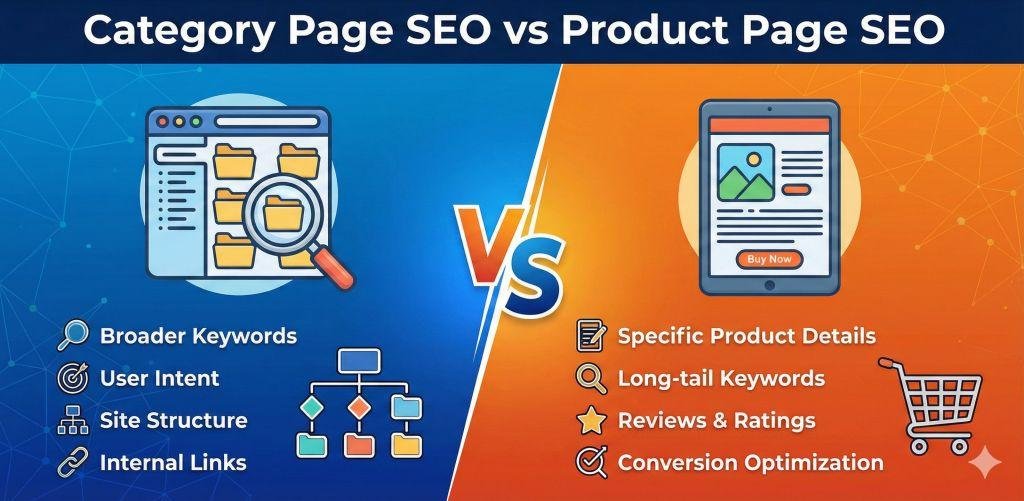
In the complex ecosystem of e-commerce, two giants fight for attention in the Search Engine Results Pages (SERPs): the broad, authoritative Category Page and the specific, conversion-driven Product Page. For business owners and marketers asking about Category Page SEO vs Product Page SEO, the answer isn’t about choosing one over the other—it’s about understanding their distinct roles in your revenue engine.
At YoGrow Solutions Pvt Ltd, we see this struggle daily. A client might have thousands of optimized products but zero organic traffic because their categories are invisible. Another might rank for high-volume terms but fail to convert. This expert guide breaks down the 2026 strategy for mastering ecommerce seo best practices across your entire site structure.
Understanding the difference is key to seo for ecommerce websites.
Category Pages are your “aisles.” They target broad, high-volume keywords (e.g., “Running Shoes,” “Office Furniture”). Their job is to pull users into the top of the funnel.
Product Pages are your “shelves.” They target specific, long-tail keywords (e.g., “Nike Air Zoom Pegasus 40 Men’s,” “Ergonomic Mesh Chair Black”). Their job is conversion rate optimization ecommerce.
In 2026, AI-driven search engines like Google SGE prioritize user intent. If a user searches for a broad term, Google wants to show a collection (Category Page). If they search for a specific model, Google wants to show the buy button (Product Page).
Your category pages are authoritative hubs. Because they house links to many products, they naturally accumulate internal link equity.
A robust ecommerce site structure starts here. Category pages should link up to parent categories (via breadcrumbs) and down to popular subcategories and products. This creates a “silo” that helps search engines understand topical relevance.
Seo ecommerce category pages must target broad terms.
Content: Avoid thin content. Add 300-500 words of helpful content at the bottom of the page explaining the category, fitting on page seo ecommerce standards.
Headers: Use H2s for “Types of [Category],” “Buying Guide,” or “Best Sellers.”
The silent killer of ecommerce SEO is faceted navigation (filters for size, color, price). Without proper technical seo, these filters generate infinite duplicate URLs.
Solution: Use canonical tags to point filter pages back to the main category URL unless there is significant search demand for a specific filter (e.g., “Red Running Shoes” might deserve its own indexable page).
Ecommerce product page seo is where the money is made. These pages must convince the user to click “Add to Cart.”
Product pages target long-tail keywords. Users landing here are ready to buy.
Tip: Don’t just copy manufacturer descriptions. That creates duplicate content. Write unique, sales-driven copy using product description seo techniques.
Nothing hurts E-E-A-T like a 404 error.
Out of Stock: Don’t delete the page. Leave it up with a “notify me” form or showcase similar products to keep the link equity.
Variants: Use proper canonicalization for color/size variants to avoid self-competition.
In 2026, structured data (Schema markup) is non-negotiable. It powers rich snippets—those star ratings, prices, and “In Stock” labels you see in Google. This directly boosts your Click-through rate (CTR).
| Feature | Category Page SEO | Product Page SEO |
| Primary Goal | Traffic acquisition (Discovery stage) | Conversion-focused (Sales) |
| Keyword Type | Broad, high-volume keywords (Head terms) | Specific, long-tail, low-volume keywords |
| User Intent | Informational / Commercial | Transactional |
| Content Needs | Category summaries, buying guides, internal links | Detailed specifications, reviews, trust signals, urgency |
| Backlink Strategy | Easier to earn authority backlinks | Harder; relies heavily on internal linking |
As a leading New York seo agency, we apply these specific tactics for our clients:
Don’t isolate them. Link from high-traffic blog posts to Category Pages, and from Category Pages to your highest-margin Product Pages. This flows authority to where it matters most.
Include an FAQ section on Category pages. Questions like “How to choose a [Category]?” help you rank for voice search and AI overviews.
With mobile optimization, ensure your filter buttons on category pages are clickable and product images are zoomable. Google indexes mobile versions first.
Both are vital, but Category Pages generally drive more organic traffic because they target broader keywords, while Product Pages drive higher conversion rates.
This is called keyword cannibalization. Ensure Category pages target general terms (e.g., “Leather Jackets”) and Product pages target specific models (e.g., “Men’s Black Biker Leather Jacket”).
Only if there is specific search volume. For example, “Size 9 Shoes” serves no SEO purpose, but “Black Wedding Dresses” is a valuable specific search term that might warrant an indexed filter page.
For ecommerce product page seo, aim for at least 300 words of unique content. Focus on benefits, specs, and answering common user questions.
Mastering Category Page SEO vs Product Page SEO requires a balanced approach. By treating your category pages as authoritative libraries and your product pages as high-performance sales floors, you build an ecommerce site structure that dominates the SERPs.
Don’t let your store get lost in the noise. Implement these ecommerce seo best practices today and watch your traffic—and revenue—climb.
Need a custom audit of your store’s architecture?
Contact YoGrow Solutions Pvt Ltd today.
Website: https://yogrowsolutions.com
Email: info@yogrowsolutions.com
Phone: +1 (571) 408-6124
Address: 418 BROADWAY, ALBANY, NY 12207






Leave A Reply Now