
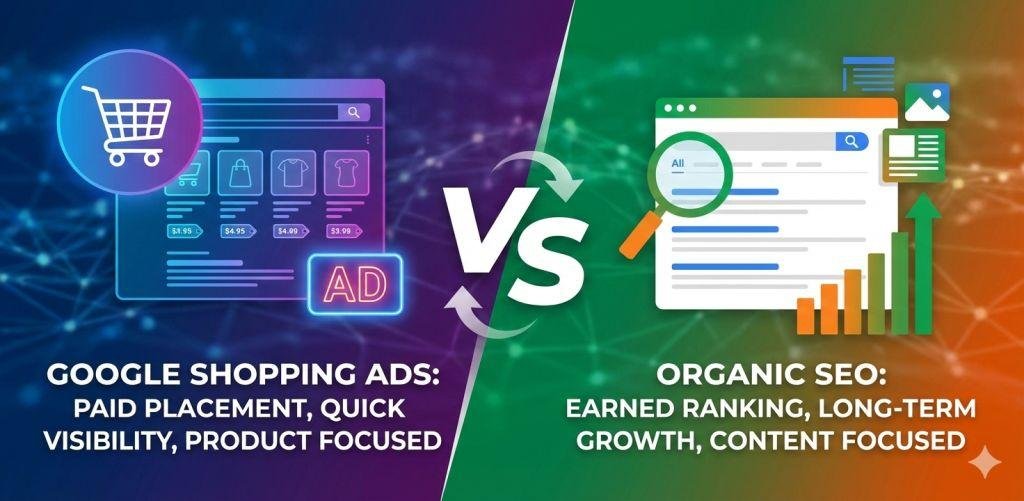
The eternal debate for e-commerce founders: Do you pay for speed (Ads) or build for longevity (SEO)?
In 2026, this isn’t just a budget question; it’s a survival strategy. Google’s Search Generative Experience (SGE) has pushed organic results further down, yet ad costs have risen by 15% year-over-year.
At YoGrow Solutions Pvt Ltd, we’ve managed millions in ad spend and generated billions in organic impressions. We don’t believe in “one or the other.” We believe in data. This guide breaks down Google Shopping Ads vs SEO to help you decide where to invest your next dollar.
Google Shopping Ads (Product Listing Ads or PLAs) are the visual cards that appear at the very top of search results, showing an image, price, and store name.
Instant Visibility: You can launch a campaign at 9 AM and get your first sale by 10 AM.
High Intent: Users see the price before they click. If they click, they are price-aware and ready to buy.
Visual Appeal: In a visual niche (fashion, decor), ads outperform text-based organic listings.
Top of Page Dominance: On mobile, Shopping Ads take up the entire first screen.
Pay-to-Play: The moment you stop paying, the traffic goes to zero.
Rising Costs (CPC): As more competitors enter, the Cost Per Click rises, eating into margins.
Feed Complexity: One wrong attribute in your specific Manufacturer Part Number (MPN) or GTIN can get your account suspended.
Best For: New product launches, seasonal sales (Black Friday), and aggressive scaling.
SEO (Search Engine Optimization) is the art of ranking your product and category pages in the organic results (“the 10 blue links” – though now often rich snippets).
“Free” Traffic: You don’t pay google for clicks. Your Customer Acquisition Cost (CAC) trends towards zero over time.
Compounding Returns: A high-ranking page can drive sales for years without additional maintenance.
Trust & Authority: 70% of users usually skip ads and click on organic results because they trust them more.
Full Funnel Targeting: You can blog about “Best running shoes for flat feet” to capture research-phase buyers (Ads usually target only “buy” phase).
Effective Speed: It takes 3-6 months to see significant traction.
Volatility: A Google Algorithm update can wipe out traffic overnight if you aren’t following E-E-A-T guidelines.
Best For: Brand building, sustainable growth, and maximizing profit margins.
| Feature | Google Shopping Ads | E-commerce SEO |
| Speed to Traffic | Instant (< 24 hours) | Slow (3–6 months) |
| Cost Model | CPC-based (Rent) | Long-term investment (Mortgage) |
| Conversion Rate | High (Visual ads + price visibility) | Medium (Depends on strong CRO) |
| Risk | Ad spend can be wasted | Algorithm updates & ranking shifts |
| Asset Value | None (Traffic stops when ads stop) | High (Compounding, increases brand & site value) |
The smartest brands don’t choose. They combine.
Here is the YoGrow Solutions “Hybrid Growth Framework”:
Use Google Shopping Ads to validate a new product. If it converts with paid traffic, you know the product page works.
Once validated, invest heavily in SEO for online store pages for those specific products. Use the keyword data from your Ad campaigns (which show you exactly what people type) to optimize your Title Tags and Descriptions.
When you rank #1 organically AND run a Shopping Ad, you take up 2x the real estate. This increases perceived authority and CTR by up to 200%.
In 2026, Google offers free listings in the Shopping Tab. This is essentially “SEO for Shopping”. You need an optimized Merchant Center feed (Structured Data), but you don’t pay for clicks. It is the perfect middle ground.
Navigating Merchant Center errors, Schema Markup, and Bid Strategies is complex.
At YoGrow Solutions, we handle the entire ecosystem:
1. Feed Management: We ensure your Shopping feed is perfect (no disapprovals).
2. Technical SEO: We build the foundation so your organic rankings climb.
3. Revenue Attribution: We show you exactly which channel drives the highest LTV (Lifetime Value).
So, Google Shopping Ads vs SEO? Ideally, the answer is “Yes”.
Use Ads to start the fire.
Use SEO to keep it burning for free.
If you ignore SEO, you will always be a slave to ad spend. If you ignore Ads, you might starve before you rank.
Ready to build a balanced revenue engine?
Website: https://yogrowsolutions.com
Email: info@yogrowsolutions.com
Phone: +1 (571) 408-6124
Address: 418 BROADWAY, ALBANY, NY 12207



Leave A Reply Now