


Author: Chetan Kumar
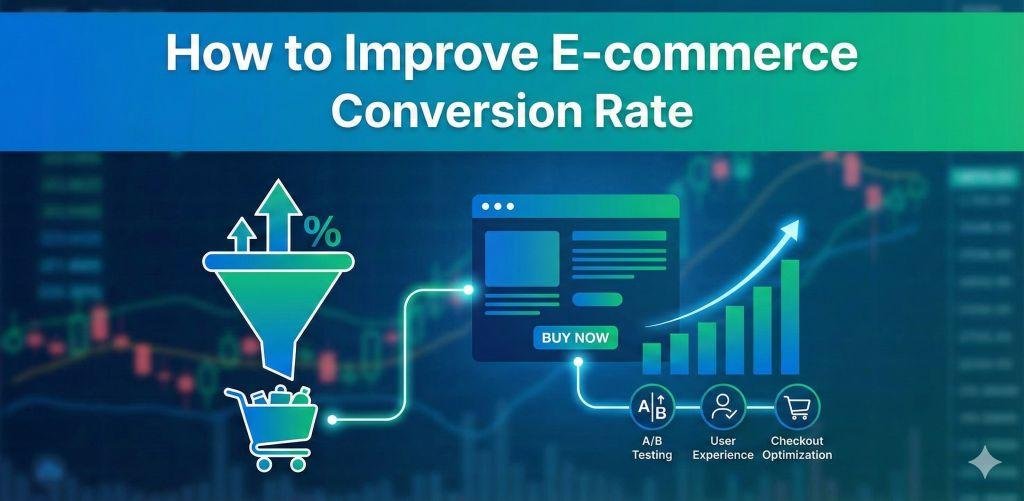
In the hyper-competitive world of 2026, driving traffic to your online store is only half the battle. The real challenge—and the key to profitability—lies in turning those visitors into paying customers. If you are asking how to improve e-commerce conversion rate, you are already asking the right question.
At YoGrow Solutions Pvt Ltd, we understand that a stagnant conversion rate isn’t just a metric; it’s lost revenue. As a top growth partner for businesses across the USA, we specialize in transforming passive browsers into loyal buyers using data-driven ecommerce strategy consulting and cutting-edge operational frameworks.
This comprehensive guide will walk you through actionable, expert-verified strategies to increase conversion rate ecommerce metrics, optimize your user journey, and ultimately maximize your revenue.
Before diving into optimization strategies, it is crucial to establish a baseline. What exactly qualifies as a good conversion rate for ecommerce?
While industry averages vary by sector (e.g., niche apparel often converts higher than high-ticket electronics), the global average ecommerce conversion rate typically hovers around 2.5% to 3%.
Top Performers: Achieve 5% or higher.
Average Performers: Sit between 2% and 3%.
Underperformers: Struggle below 1.5%.
However, B2B conversion rates often function differently, with longer sales cycles but higher average order values. Understanding where you stand is the first step in ecommerce monitoring and improvement.
To truly improve conversion rate ecommerce results, you need a holistic approach that covers technical performance, user experience, and trust-building.
Your product page is your digital salesperson. If it isn’t convincing, you lose the sale.
High-Quality Visuals: Use 360-degree views, videos, and high-res zoom.
Clear Value Propositions: Don’t just list specs; explain benefits.
Social Proof: prominent reviews and “rate shoppers” data.
Friction is the enemy of conversion.
Guest Checkout: Mandating account creation is a top reason for cart abandonment.
Multiple Payment Options: From credit cards to digital wallets and Buy Now, Pay Later (BNPL).
Optimized Forms: Use auto-fill address validation to speed up the process.
Modern digital commerce platforms allow for deep personalization.
Recommendation Systems: Deploy a recommendation system for e commerce that suggests products based on browsing history, similar to Amazon’s “Frequently Bought Together.”
Dynamic Content: Show personalized offers based on the user’s location or past behavior.
You cannot improve what you do not measure. Ecommerce testing is non-negotiable.
Test headlines, button colors, layout changes, and offer phrasing.
Use data to back every decision, moving away from “gut feelings.”
In 2026, mobile commerce dominates.
Ensure your site is responsive and loads instantly.
Design touch-friendly interfaces.
Simplify mobile navigation to reduce bounce rates.
Customers today expect a seamless experience across devices and platforms. An omnichannel commerce platform ensures that a customer can start their journey on Instagram, research on their laptop, and buy on their phone without losing context. Multi channel ecommerce strategies are essential for capturing high-intent traffic wherever it exists.
High returns kill profitability. Addressing ecommerce return rates is a hidden conversion optimization hack.
Accurate Sizing Guides: vital for apparel.
Detailed Descriptions: Set realistic expectations to reduce “item not as described” returns.
Easy Returns Policy: Paradoxically, a lenient return policy builds trust and increases conversion rate ecommerce figures.
For those in the B2B space, B2B e-commerce strategy requires focusing on:
Bulk Ordering Capabilities.
Custom Pricing Tiers.
Quick Re-order Lists.
Since B2B conversion rates rely heavily on trust and long-term relationships, ecommerce development solutions for B2B must prioritize efficiency and account management features.
Trust is the currency of the internet.
Secure Badges: Display SSL and payment security seals.
Transparent Policies: Clear shipping and return info.
Customer Service: Accessible ecommerce customer service (live chat, chatbots) can answer last-minute doubts and close the sale.
Why chooses generic advice when you can partner with experts? At YoGrow Solutions Pvt Ltd, we don’t just guess; we engineer growth.
Custom Audits: We analyze your specific ecommerce operations to find bottlenecks.
Technical Excellence: Our ecommerce development solutions ensure your site is fast, secure, and ready for scale.
Strategic Growth: From cross border ecommerce solutions to local SEO, we handle it all.
We are different because we treat your business like our own. Our New York-led team combines global expertise with local market understanding to deliver ecommerce conversion rate optimization services that actually work.
Focus on site speed, remove checkout friction (enable guest checkout), and add high-quality product images. These are high-impact, low-effort wins.
Global averages are around 2.5% – 3%, but this varies highly by industry.
This often indicates a disconnect between user intent and your landing page, poor user experience (UX), or lack of trust signals (reviews, security badges).
Yes. Ecommerce testing helps you scientifically determine what works best for your specific audience, leading to incremental but compounded growth.
Improving your e-commerce conversion rate is an ongoing journey of optimization, testing, and refinement. By implementing these strategies—from technical ecommerce testing to strategic omnichannel commerce integration—you can transform your store into a high-performance sales machine.
Ready to take your sales to the next level?
Contact YoGrow Solutions Pvt Ltd today.
Website: https://yogrowsolutions.com
Email: info@yogrowsolutions.com
Phone: +1 (571) 408-6124
Address: 418 BROADWAY, ALBANY, NY 12207





Leave A Reply Now