


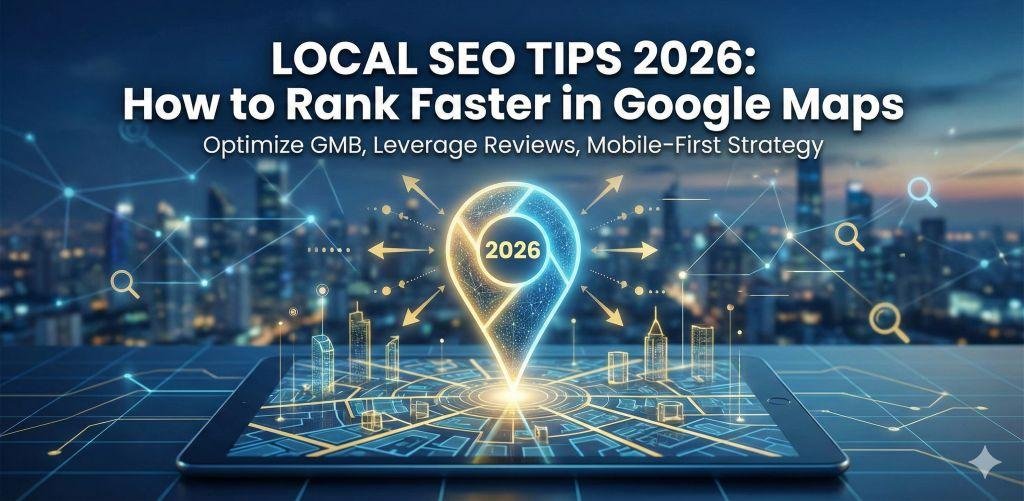
In the hyper-competitive world of local search, visibility is everything. For brick-and-mortar businesses and service providers in the US, ranking in the Google Maps “Local Pack” (the top 3 listings) is the holy grail of digital marketing. As we move into 2026, the algorithms governing these rankings are becoming smarter, prioritizing user experience, behavioral signals, and genuine authority over old-school keyword stuffing.
If you’re asking, “How do I rank higher on Google Maps?” you’re not alone. But the answer has evolved. It’s no longer just about claiming your listing; it’s about optimizing an entire ecosystem around your brand.
This guide outlines actionable Local SEO tips to help you dominate the Map Pack and drive more foot traffic and calls to your business.
Your Google Business Profile is the foundation of your local presence. It is not a “set it and forget it” tool.
Google favors completeness. Ensure your business name, address, and phone number (NAP) are accurate. Choose the most relevant primary category and utilize secondary categories to cover all your services.
Images are a conversion factor. Upload high-resolution photos of your team, office, and completed projects. Geotagging photos can provide subtle location signals to Google, reinforcing your relevance to the local area.
Treat your GBP like a social media feed. Regular updates about offers, events, or new content create fresh signals for Google. Use Google Business Profile Posts to highlight specific services and include LSI keywords like “emergency repair” or “consultation.”
Online reputation management is a critical ranking factor. A steady stream of positive reviews tells Google that your business is trustworthy and active.
· Get More Google Reviews: meaningful quantity matters. Implement a system to ask happy customers for reviews via email or SMS.
· Respond to Google Reviews: Engagement is key. Respond to every review—positive or negative. Using keywords in your responses (e.g., “Thanks for choosing us for your plumbing repair in Austin”) can help, but keep it natural.
Proximity is the #1 ranking factor for local search, but it’s the hardest to control. You can’t move your office, but you can optimize for Near Me Search Optimization.
· Create Location Pages: If you serve multiple areas, create dedicated landing pages for each city or neighborhood. content should be unique and tailored to that specific locale.
· Embed a Map: Embed a Google Map on your “Contact Us” and location pages to reinforce your physical location.
Your website feeds information to your Maps listing.
· Local Schema Markup: Implement structured data (LocalBusiness schema) to feed search engines precise details about your hours, location, and services.
· Mobile Optimization: Over 80% of “near me” searches happen on mobile. Ensure your site is lightning fast and mobile-friendly. Mobile Optimization for Local SEO is non-negotiable.
· NAP Consistency: Ensure your Name, Address, and Phone number are identical across your website, GBP, and all directories. Even small discrepancies (e.g., “St.” vs. “Street”) can confuse the algorithm.
Authority isn’t just global; it’s local.
· Local Citations: Get listed on reputable local directories (Yelp, Yellow Pages, Chamber of Commerce). Local Citations for SEO validate your business existence.
· Local Link Building: Partner with other local businesses, sponsor local events, or get featured in local news. A link from a local church or school website is often more valuable for Maps ranking than a link from a generic high-DA site.
Google is increasingly looking at how users interact with your listing.
· CTR (Click-Through Rate): A compelling business title and high star rating encourage clicks.
· Dwell Time: Do users stay on your site after clicking?
· Direction Requests: High volumes of users asking for directions signal real-world popularity.
Ranking in Google Maps requires a blend of technical expertise, creative content, and strategic outreach. At YoGrow Solutions, we don’t just guess; we engineer success.
Our approach to Local SEO Strategy 2026 is data-driven and E-E-A-T compliant. We help US businesses:
· Conduct deep Local SEO Audits to identify gaps.
· Execute precision Local Link Building campaigns.
· Manage Google Business Profile Optimization to keep you in the top 3.
Don’t let your competitors steal your local customers.
Partner with the experts who understand the nuances of the US market. Contact YoGrow Solutions today.
· Website: https://yogrowsolutions.com
· Email: info@yogrowsolutions.com
· Phone: +1 (571) 408-6124
· Address: 418 BROADWAY, ALBANY, NY 12207




Leave A Reply Now