


In the digital marketing world, “SEO” is often thrown around as a catch-all term. But for business owners and marketers in 2026, understanding the nuance between Local SEO vs Traditional SEO isn’t just semantics—it’s the difference between dominating your city and getting lost in the global noise.
While both strategies aim to improve visibility on search engines, they operate on fundamentally different algorithms, target different audiences, and require distinct tactical playbooks.
At a high level:
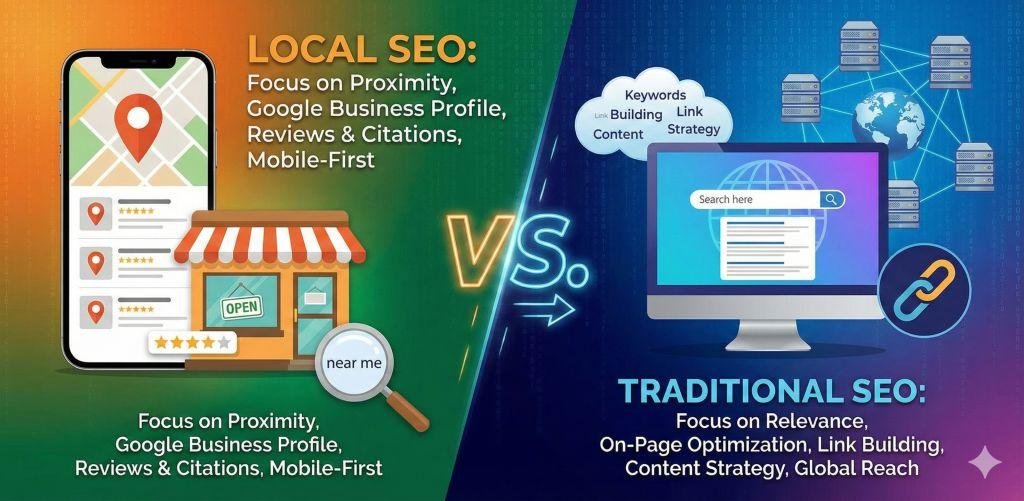
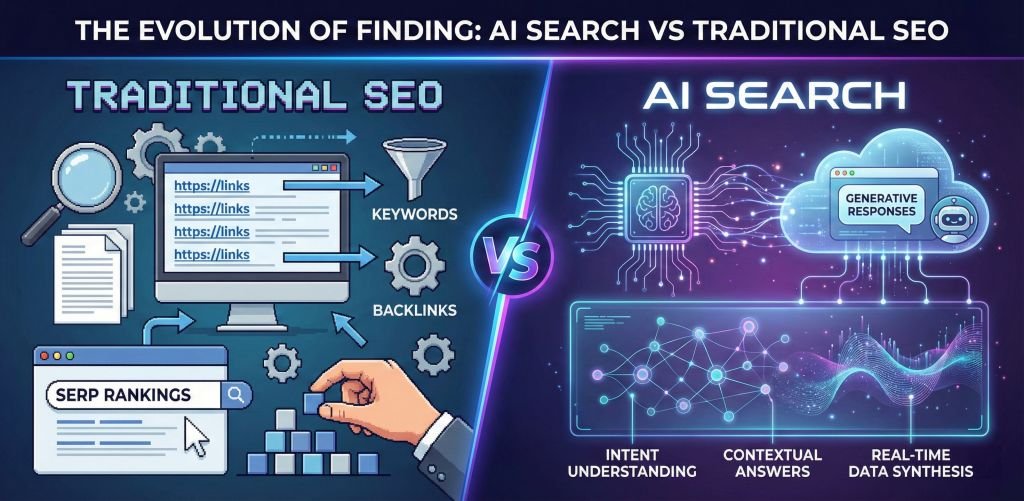
Traditional SEO (National/Organic SEO) focuses on ranking a website for keywords globally or nationally (e.g., “best running shoes”). It targets users seeking information or products regardless of their location.
Local SEO focuses on ranking a business for geographically specific queries (e.g., “running shoe store near me”). It targets users with immediate, physical intent.
In 2026, the gap has widened. Google’s Search Generative Experience (SGE) treats these two intent types uniquely, serving AI summaries for informational queries (Traditional) while prioritizing the “Map Pack” for navigational ones (Local).
For traditional SEO techniques, the algorithm prioritizes:
Content Depth: How well do you answer the user’s query?
Domain Authority: How many high-quality backlinks point to your site?
Technical Health: Is your site fast, crawlable, and secure?
For Local SEO, the algorithm (specifically for the Local Pack/Maps) adds three critical layers:
Proximity: How close is the searcher to your business?
Prominence: How well-known is the business offline (citations, reviews)?
Relevance: Does your Google Business Profile optimization match the query?
> Key Insight: You can have a lower domain authority than your competitor but still outrank them locally if your proximity and GMB signals are stronger.
Local SEO thrives on geocentric keywords. These are terms with explicit or implicit location markers.
Explicit: “Plumber in Albany NY”
Implicit: “Emergency plumber” (searched on a mobile device)
In 2026, near me search optimization is non-negotiable. Google’s neural matching understands that “coffee shop” effectively means “coffee shop near me” when searched on a phone.
Traditional SEO targets broad, often educational keywords.
“How to fix a leaky faucet”
“Benefits of vegan diet”
“Best CRM software for startups”
The user here isn’t looking for a location; they are looking for an answer. This is where organic SEO vs local SEO deviates most—Local answers “where,” Traditional answers “what” and “how.”
Local SEO fights for the “Local Pack” (the 3-pack map listing). This is prime real estate that appears above traditional organic results. Factors like NAP consistency SEO (Name, Address, Phone) and review velocity drive these rankings.
Traditional SEO fights for the “Blue Links” (organic listings below the ads and maps). Here, local link building helps, but national media mentions and long-form content are the heavy hitters.
To win locally, your content must be hyperlocal. A general “About Us” page isn’t enough. You need:
Location pages for every city you serve.
Blog posts about local events or partnerships.
CASE STUDIES: “How we helped a [City Name] family save on energy bills.”
National SEO strategy demands “Evergreen” content that appeals to everyone.
“The Ultimate Guide to Energy Efficiency.”
“Top 10 Trends in Interior Design.”
This content attracts backlinks from all over the world, boosting your overall domain authority.
Benefits of local SEO often include a faster path to revenue. Why?
Lower Competition: You are only competing with businesses in your radius, not the whole world.
Higher Intent: A user searching “dentist open now” has a credit card ready. A user searching “good dental hygiene” is just reading.
Traditional SEO is a long game. It often takes 6-12 months to see significant movement for competitive national keywords, but the scalability is infinite.
| Feature | Local SEO | Traditional SEO |
| Primary Target | Local customers (Cities / Regions) | National / Global audience |
| Key Asset | Google Business Profile (GBP) | Website content |
| Reviews | Critical (Google Reviews) | Less critical (Trustpilot, etc.) |
| Link Building | Local citations & sponsorships | High-DA industry links |
| Conversion Funnel | Instant (Calls / Visits) | Longer (Research & nurturing) |
Choose Local SEO if: You have a physical storefront (restaurant, retail) or serve a specific geographic area (plumber, lawyer, doctor). The goal is foot traffic and phone calls.
Choose Traditional SEO if: You sell products online (e-commerce), offer digital services (SaaS, consulting), or are a publisher. The goal is traffic and brand authority.
Choose Both if: You are a national franchise or a local business expanding regionally. Omnichannel marketing local SEO strategies allow you to capture both the researcher and the buyer.
Navigating local SEO ranking factors 2026 requires technical expertise and strategic nuance. At YoGrow Solutions, we don’t believe in cookie-cutter approaches. We analyze your business model to deploy the right weapon for the right battle.
Whether you need to dominate the Map Pack in New York or rank nationally for “Best SEO Agency,” our team builds data-driven campaigns that deliver revenue, not just rankings.
We specialize in:
Advanced Google Business Profile Management
Hyperlocal Content Creation
Schema Markup Implementation
Entity-Based Authority Building
Ready to stop guessing and start growing?
Contact YoGrow Solutions today.
Website: https://yogrowsolutions.com
Email: info@yogrowsolutions.com
Phone: +1 (571) 408-6124
Address: 418 BROADWAY, ALBANY, NY 12207



Leave A Reply Now