


Author Asif Rajput | Senior SEO Strategist
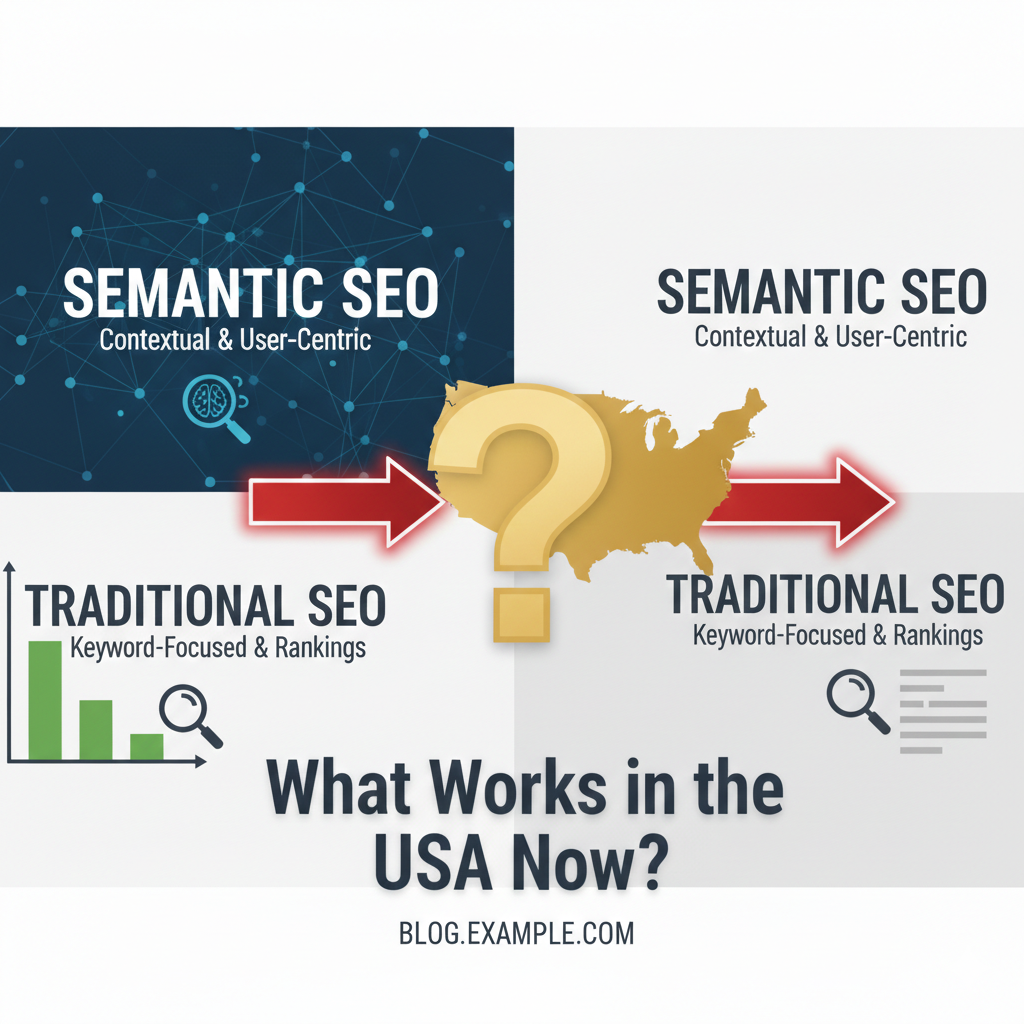
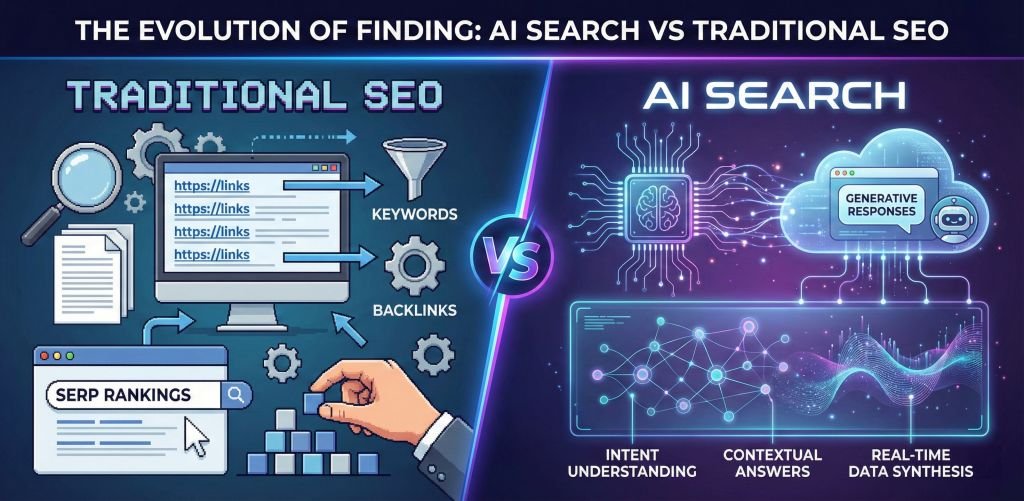
The digital landscape in the USA has shifted seismically. If you are still stuffing keywords into meta tags and counting on exact-match phrases to rank, you are fight a losing battle. The year is 2026, and the battleground has moved from Traditional SEO to Semantic SEO.
At YoGrow Solutions Pvt Ltd, we see this shift every day. US businesses that cling to old-school tactics are seeing their visibility vanish into the “hidden gems” filter, while those embracing semantic strategies are dominating the AI-powered Snapshots and Knowledge Panels.
This comprehensive guide will break down exactly why Traditional SEO is dying, what Semantic SEO actually is, and how you can leverage it to dominate the US e-commerce market.
Traditional SEO was simple. It was mechanical. You found a keyword with high volume—let’s say “best running shoes”—and you repeated it 2% to 3% of the time in your content. You built backlinks with that exact anchor text. It was a game of math and manipulation.
But Google’s algorithms (BERT, MUM, and their 2026 successors) grew up. They stopped reading strings of text and started understanding things.
If your strategy is solely focused on individual keywords, you are optimizing for a search engine that hasn’t existed since 2015.
Semantic SEO is the practice of optimizing content around *topics*, *entities*, and *user intent*, rather than just individual keywords. It’s about depth, context, and meaning.
When a user searches for “running shoes,” they aren’t just looking for a definition. They might want to buy them (transactional), read reviews (commercial), or know how to fit them (informational). Semantic SEO answers allthese needs in a connected web of content.
In Traditional SEO, “Apple” is just a 5-letter word. In Semantic SEO, Google understands “Apple” as an Entity:
By mapping these relationships, Semantic SEO helps you rank for thousands of related long-tail keywords without even trying to target them all explicitly.
The rise of AI Search Engines and Google’s Search Generative Experience (SGE) has accelerated the need for semantic strategies. AI doesn’t just match keywords; it synthesizes answers.
SGE reads your content to understand the *nuance*.
AI Overviews prioritize content that is structured, authoritative, and direct.
Zero-Click Searches mean your value must be clear globally, not just on your page.
To appear in these AI snapshots, your content must be the most authoritative source of truth on the entity you are discussing.
Before you write a single word, ask: What does the user actually want
In 2026, misaligning intent is the #1 reason for ranking failure.
Don’t write one lonely post about “SEO”. Build a Topic Cluster:
This signals to Google that you are an authority on the broader topic, not just a lucky ranker for one term.
Use natural language. Speak about related concepts. If you are writing about “Pizza,” you *mustmention “dough,” “sauce,” “oven,” “Italy,” “delivery.” If you miss these semantically related terms (LSI keywords), Google doubts your depth.
Current algorithms crave E-E-A-T:
Pro Tip: Include author bios, real-world data, and original photography.*
You must speak Google’s language. Use Schema Markup*to explicitly tell search engines what your content is.
People talk to their devices. “Hey Google, where can I find the best SEO agency near me?”
Your content should answer these conversational queries directly. Use natural, spoken-language phrasing in your H2s and H3s.
Internal links are the nerves of your website. They pass authority from your power pages to your new pages. Use descriptive anchor text (e.g., “learn more about semantic search,” not “click here”).
At YoGrow Solutions Pvt Ltd, we don’t just “do SEO.” We engineer growth.
While most agencies are still sending you monthly reports full of vanity metrics and keyword rankings that don’t convert, we focus on Entity Authority.
Data-Driven Clusters: We use proprietary AI tools to map out the exact topic clusters your competitors are missing.
Semantic Audits: We analyze your content’s “meaning” score against top-ranking US competitors.
Future-Proofing: We optimize for the search engines of tomorrow (SGE, AI), ensuring your traffic doesn’t tank when the next algorithm update hits.
We position you not just as a choice, but as the *correctchoice in your industry.
Not entirely. Technical foundations (site speed, mobile friendliness) are still vital. But keyword stuffing and isolated keyword targeting are dead.
Semantic strategies build authority using topic clusters. This typically takes 3-6 months to show significant compound growth, but the results are far more stable than traditional volatility.
You don’t needit, but AI tools help immensely in analyzing large datasets of entities and relationships that a human might miss.
Absolutely. Local SEO is heavily semantic. Google needs to understand the relationship between your business entity, your location, and your services to rank you in the Local Pack.
The shift from Traditional to Semantic SEO is not a trend; it’s the evolution of the internet. In the US market, where competition is fierce and AI is ubiquitous, you cannot afford to be broad and shallow. You must be deep and meaningful.
By focusing on user intent, building robust topic clusters, and signaling E-E-A-T, you can future-proof your digital presence.
Ready to stop chasing algorithms and start leading your industry? Contact YoGrow Solutions Pvt Ltd today for a semantic content audit and let’s build your authority together.


Leave A Reply Now