


Are you visible where it matters most?
For businesses in the USA—whether you’re a boutique in New York, a clinic in Los Angeles, or a law firm in Chicago—the battleground for customers is no longer just your website. It is your Google Business Profile (GBP).
In 2026, Google Maps is not just a navigation tool; it is an AI-powered local search engine. With the integration of Google Gemini and the rise of Zero-Click Searches, your potential customers are deciding to buy from you (or your competitor) without ever visiting your website.
At YoGrow Solutions, we understand that Google Business Profile optimization is the single most impactful strategy for driving local leads. This comprehensive guide will walk you through the advanced, entity-based strategies required to dominate the Local Pack in the US market.
The landscape of local SEO for Google Business Profile has shifted dramatically.
· The AI Revolution: Google’s AI can now “read” your photos, understand the sentiment of your reviews, and correlate your business entity with real-world locations better than ever.
· Zero-Click Dominance: Over 60% of local searches end on the Google results page. Users get their answer (your phone number, hours, address) directly from your profile. if your profile is incomplete, you lose the lead.
· Hyper-Local Competition: In dense US cities, ranking radii have shrunk. You might rank #1 for a user two blocks away, but #10 for a user a mile away. Proximity is key, but Prominence is the equalizer.
To succeed, you need more than just a verified listing. You need a data-driven Google Maps SEO strategy.
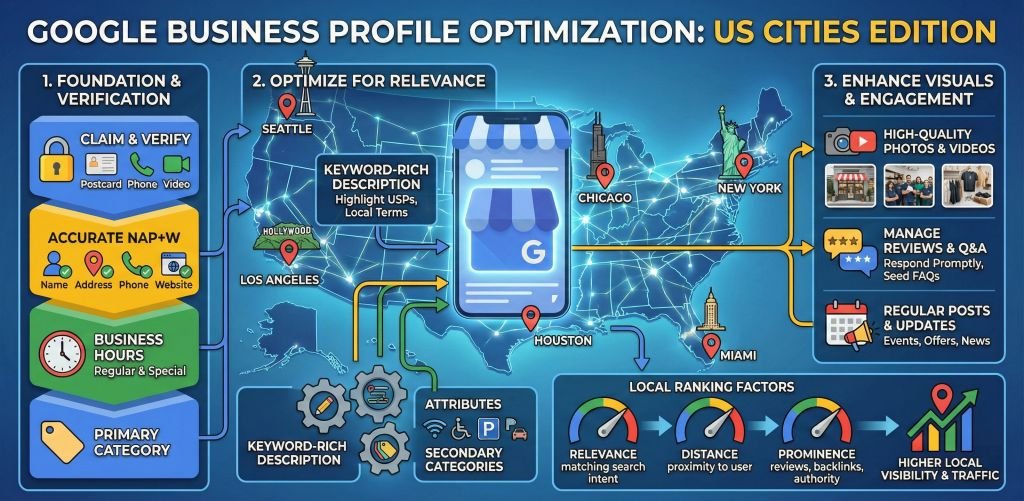
Google’s local algorithm is built on three pillars. Understanding them is critical to optimize Google Maps listings effectively.
1. Relevance: “Is this what I’m looking for?”
Does your business match the user’s search intent? This goes beyond keywords. It’s about ensuring your Google Business Profile categories, business description, and on-site content send a clear signal about who you are.
· 2026 Update: Google now uses “Entity SEO” to verify your relevance. If your GBP says “Pizza,” but your website talks about “Burgers,” you lose trust.
2. Distance: “Is it nearby?”
This refers to the physical distance between the searcher and your business.
· Optimization Tip: While you can’t move your office, you can optimize for service area signals if you are a service-based business (SAB). However, strictly defining your service areas (e.g., specific zip codes in Houston or Miami) helps Google understand where you operate.
3. Prominence: “Is this business popular?”
This is where YoGrow Solutions excels. Prominence is based on information Google has about a business from across the web.
· Key Drivers: Review count and score, local citations USA, backlinks, and articles.
· The Secret Sauce: Famous brands rank higher even if they are further away. Building your digital authority is non-negotiable.
Follow this checklist to transform your profile into a conversion machine.
Step 1: Master Nap Consistency
NAP (Name, Address, Phone Number) consistency is the foundation of local SEO.
· Ensure your business name is exactly the same on your GBP, your website, and high-authority directories (Yelp, YellowPages, BBB).
· Warning: Do not stuff keywords into your business name (e.g., “Best Lawyer NYC”). This is a common Google Business Profile mistake that leads to suspension.
Step 2: Strategic Category Selection
Your Primary Category has the biggest impact on rankings.
· Be Specific: Don’t just pick “Restaurant.” Pick “Southern Italian Restaurant.”
· Secondary Categories: Utilize all relevant secondary categories to capture long-tail keywords. A “Dentist” should also select “Cosmetic Dentist,” “Dental Implants Periodontist,” etc.
Step 3: Entity-Optimized Business Description
Your business description isn’t just for humans; it’s for Google’s AI.
· Action: Write a natural, compelling description that includes your USP and key services.
· Keyword Integration: “Leading Google Business Profile optimization services provider in Albany, helping businesses across the USA.”
· Structure: Use the first 250 characters to convey your most important value proposition.
Step 4: The Power of Geo-Tagged Photos
Visual search optimization is rising.
· Upload high-quality images of your team, office, and completed projects.
· Pro Tip: In 2026, simply uploading isn’t enough. Ensure your photos have EXIF data (geo-tags) or are associated with your specific location history. This validates your physical presence to Google’s NavBoost signals.
Step 5: Service & Product Editor
Don’t leave these blank!
· Services: List every specific service you offer with a price (if applicable) and a 300-word description containing LSI keywords.
· Products: If you are an e-commerce or retail business, use the Product Editor. These often appear directly in the search results, driving high CTR (Click-Through Rate).
A Review Strategy that Converts
Review management strategy is about more than just saying “thanks.”
· Keywords in Reviews: Encourage happy clients to mention the specific service they received. “YoGrow Solutions did an amazing job with my local SEO!” creates a powerful keyword association.
· Response Rate: Reply to every review within 24 hours. This signals to Google that you are an active, responsive business.
Leveraging Google Posts
Think of Google Posts as your free ad space in the local pack.
· Frequency: Post at least once a week.
· Content: Share offers, events, or “New Service” announcements.
· Call to Action: Always include a “Call Now” or “Book Online” button.
Advanced Tactics: Authority & AI
Citations (mentions of your business on other websites) validate your existence.
· Focus on quality over quantity. A citation from a local Chamber of Commerce in Dallas is worth 100 spammy directory links.
· Niche Directories: If you are in real estate, get listed on Zillow and Realtor.com. If you are in healthcare, look for HealthGrade and Vitals.
With voice search optimization for local business growing, people are asking Siri and Alexa: “Who is the best divorce lawyer near me?”
· Conversational Keywords: Optimize your FAQ section on your website and GBP Q&A with natural language questions.
· Structured Data: Ensure your website uses LocalBusiness Schema markup to feed data clearly to search engines.
1. Duplicate Listings: Ensure you don’t have old, unclaimed profiles floating around.
2. Fake Reviews: Never buy reviews. Google’s 2026 filters are ruthless and will wipe them out, potentially suspending your listing.
3. Ignoring Q&A: Anyone can ask a question on your profile. If you don’t answer, a random user might (and they might give the wrong info!).
Optimizing a Google Business Profile for a competitive US city requires time, expertise, and advanced tools.
At YoGrow Solutions, we specialize in entity-based local SEO. We don’t just “fill out forms.” We build a digital footprint that positions your business as the market leader.
· Comprehensive Audits: We identify exactly why your competitors are outranking you.
· Content Strategy: We create the local content needed to support your map rankings.
· Spam Fighting: We efficiently report effective spam to clear the way for your legit business.
Ready to dominate the Local Pack?
YoGrow Solutions Pvt Ltd – Your Partner in Growth.
· Website: https://yogrowsolutions.com
· Email: info@yogrowsolutions.com
· Phone: +1 (571) 408-6124
· Address: 418 BROADWAY, ALBANY, NY 12207
Typically, businesses see initial improvements in 30-60 days. However, for competitive markets like Google Business Profile optimization New York or Los Angeles, it can take 3-6 months of consistent effort to hit the top 3.
Yes! It sends “active” signals to Google and increases user engagement (clicks), which is a key ranking factor in 2026.
Basic management services start around $300-$500/month, while comprehensive, aggressive local SEO campaigns for multi-location businesses can range from $1,000 to $3,000+ per month.
You can, but without expert knowledge of Google Maps ranking factors 2026, you might miss critical opportunities or make mistakes that limit your visibility.




Leave A Reply Now