


For US B2B companies in 2026, the era of “spray and pray” lead generation is officially dead. The future belongs to precision. It belongs to Account-Based Marketing (ABM).
With B2B buying cycles getting longer and buying committees expanding to an average of 14 stakeholders, generic marketing no longer cuts it. Today, 64% of US B2B enterprises are increasing their ABM investment because it delivers the highest ROI of any B2B marketing strategy.
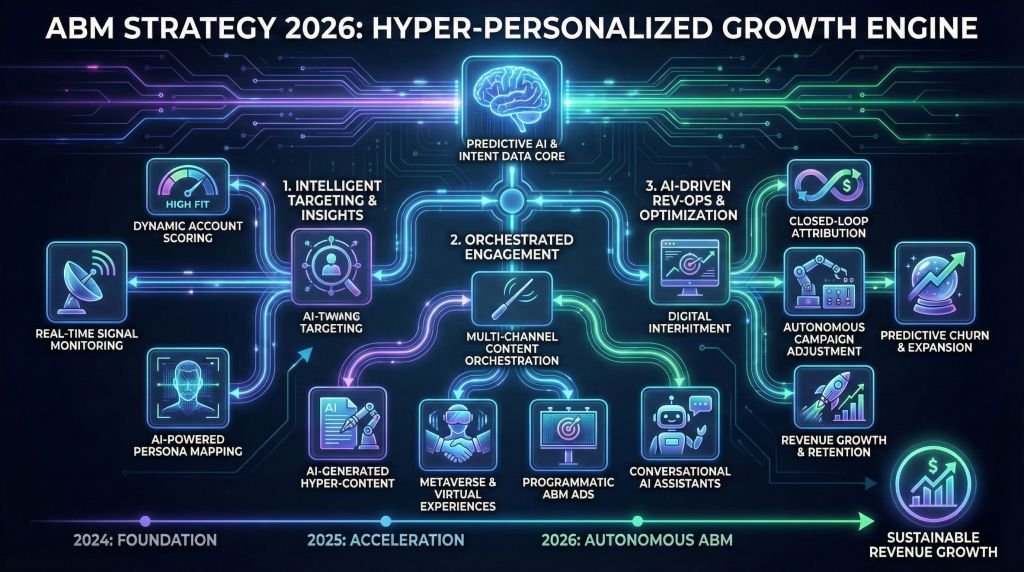
But ABM in 2026 isn’t just about targeting accounts; it’s about orchestrating an Account-Based Experience (ABX) powered by AI and real-time intent data.
This guide provides a battle-tested ABM framework for US companies, designed to help you align sales and marketing, penetrate high-value accounts, and accelerate your pipeline.
Account-based marketing strategy USA has evolved. It is no longer a niche tactic for a few “whale” accounts. It is now the dominant Go-To-Market (GTM) motion for high-growth B2B firms.
Traditional ABM focused on firmographics (Company Size, Industry). ABM strategy for B2B in 2026 focuses on behavioral signals and buying networks.
Old ABM: Sending cupcakes to the CEO of a Fortune 500 company.
2026 ABM: Using AI to detect when the VP of Engineering at a target account searches for “enterprise security solutions,” and immediately serving them personalized LinkedIn ads while alerting the sales team.
To execute a successful enterprise ABM strategy, you need to build on three core pillars: Data, Content, and Orchestration.
Success/failure is determined before you launch a single campaign. It starts with your Ideal Customer Profile (ICP).
Don’t just guess. Use predictive analytics to identify accounts with high “propensity to buy.”
Target Account Selection Criteria:
Firmographics: Revenue >$50M, US-based HQ.
Technographics: Do they use Salesforce? AWS? (Critical for tech integrations).
Intent Data: Are they actively researching ABM services USA or your competitors?
You aren’t selling to a company; you are selling to a specific group of people.
The Decision Maker: CFO / CEO (Cares about ROI).
The Champion: VP of Marketing / Head of Sales (Cares about efficiency).
The Blocker: IT / Legal (Cares about compliance).
Buying committee targeting requires mapping these roles and creating distinct content tracks for each.
Personalized B2B campaigns are the heart of ABM.
Level 1 (1:Many): Industry-specific landing pages (e.g., “ABM for Healthcare”).
Level 2 (1:Few): Cluster-based webinars (e.g., “ABM for Series B FinTechs”).
Level 3 (1:1): Account-level personalization (e.g., A custom microsite for “Microsoft” tailored to their specific pain points).
Forget the traditional lead funnel. The ABM funnel strategy is inverted.
1. Identify: potential best-fit accounts (not leads).
2. Expand: Map the buying committee and engage key contacts.
3. Engage: Execute multi-channel ABM campaigns (LinkedIn, Email, Direct Mail).
4. Advocate: Turn customers into partners (Retention/Expansion).
Using intent data for ABM is non-negotiable. Tools like 6sense or Demandbase allow you to see “dark funnel” activity.
Actionable Tactic: If an account spikes in intent for “B2B marketing automation,” trigger a sales and marketing alignment play where SDRs reach out within 24 hours.
Not all accounts deserve the same level of resource investment.
| Strategy Type | Target Volume | Resource Intensity | Best For |
| One-to-One ABM (Strategic) | 5–50 accounts | High (custom reports, events) | 6–7 figure enterprise deals |
| One-to-Few ABM (Segmented) | 50–200 accounts | Medium (vertical content) | Mid-market growth |
| One-to-Many ABM (Programmatic) | 200+ accounts | Low (tech-enabled scaling) | Programmatic ABM and volume |
The #1 reason ABM fails is friction between Sales and Marketing.
Marketing’s Job: Warm up the account, build brand trust, and surface intent.
Sales’ Job: multi-thread stakeholders, personalized outreach, and close the deal.
The Metric that Matters: Pipeline Velocity and Account Engagement Score, no longer “MQLs.” This is true sales and marketing alignment.
Challenge: A US-based Fintech struggled to break into the Enterprise Banking sector.
Strategy: Implemented Strategic ABM.
Selected 30 top tier banks.
Created account scoring models based on regulatory compliance needs.
Sent direct mail “Compliance Kits” to C-suite executives.
Result: 40% increase in pipeline acceleration and $12M in closed revenue within 12 months.
As we look ahead, ABM for US enterprises will become autonomous.
AI Agents: Will conduct account research and write personalized emails better than humans.
Unified Data: The separation between “ABM platform” and “CRM” will disappear.
B2B Marketing Strategy USA will shift entirely to “Revenue Operations” (RevOps).
Building an ABM marketing plan in 2026 requires a shift in mindset. It’s about quality over quantity. It’s about data over intuition.
Whether you are building an in-house team or hiring an ABM agency USA, the path to winning the US B2B market lies in your ability to treat every target account like a market of one.
Ready to transform your pipeline? Start by defining your ICP and pilot a One-to-Few ABM campaign today.
YoGrow Solutions Pvt Ltd – Your Partner in Growth.
· Website: https://yogrowsolutions.com
· Email: info@yogrowsolutions.com
· Phone: +1 (571) 408-6124
· Address: 418 BROADWAY, ALBANY, NY 12207
Lead generation fishes with a net (quantity). ABM fishes with a spear (quality). ABM focuses on high-value accounts rather than individual leads.
While platforms like RollWorks help, you can start with a manual ABM framework for US companies using LinkedIn Sales Navigator and a CRM.
ABM is a marathon, not a sprint. Typically, it takes 3-6 months to see impact on pipeline and 6-12 months for revenue, but the deal sizes are significantly larger.
Programmatic ABM uses technology to automate personalization across hundreds of accounts, blending broad reach with account-level relevance.



Leave A Reply Now