


In the fast-paced world of online retail, you don’t always have weeks to conduct a forensic analysis. Sometimes, you need a quick SEO audit ecommerce strategy that identifies the “bleeding neck” issues immediately.
Whether you are preparing for Black Friday or recovering from a traffic drop, this 3 day SEO audit process is designed to be ruthless and efficient. We will bypass the fluff and focus on the technical SEO issues in ecommerce that actually impact revenue.
This guide will show you exactly how to audit an ecommerce website for SEO in just 72 hours, covering everything from crawlability and indexation issues to category page SEO optimization.
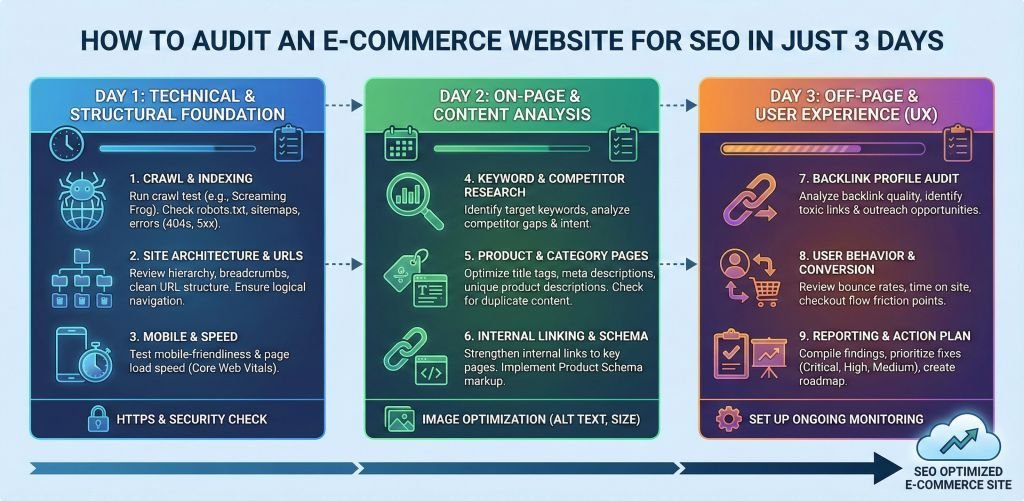
Day 1: Technical Health & Site Architecture (The Foundation)
Day 2: On-Page Content & Semantics (The Relevance)
Day 3: Authority, Speed & Competitors (The Trust)
—
Your first 24 hours are dedicated to ensuring search engines can access and understand your store. If they can’t crawl it, they can’t rank it.
Start your technical SEO audit for ecommerce by running a crawl (using Screaming Frog or Sitebulb).
Status Code Errors: Fix all 404s (broken links) and 5xx errors immediately. Redirect 404s to the nearest relevant category, not the homepage.
Robots.txt & Sitemaps: Ensure your `sitemap.xml` is clean (no 404s/redirects inside it). Check `robots.txt` to ensure you aren’t blocking critical JS/CSS files.
Orphan Pages: Identify money pages with zero internal links. These are dead ends for bots.
Faceted navigation SEO is the most common killer of ecommerce budgets.
Parameter Handling: Check if filtering by “Color: Blue” + “Size: M” creates a unique, indexable URL. If so, you may have millions of low-value pages.
Canonical Tags: Ensure all filtered pages canonicalize back to the main category page unless they have significant search volume (e.g., “Red Nike Running Shoes”).
Pagination SEO Issues: unique content must exist on paginated series (Page 2, Page 3). Use self-referencing canonicals for paginated pages in 2026.
Depth to Click: No product should be more than 3 clicks from the homepage.
Breadcrumbs: Verify `Schema.org` markup for breadcrumbs. They are vital for ecommerce site structure audit and user navigation.
—
Now that the technical foundation is solid, Day 2 focuses on relevance. We need to tell Google exactly what we sell.
Category pages are your highest-traffic assets.
H1 & Meta Tags: Ensure unique, keyword-rich H1s. Avoid “Men’s” -> use “Men’s Leather Jackets”.
Introductory Content: Add 100-200 words of unique descriptive text. This helps with category page SEO optimization.
Internal Linking: Link to high-margin products directly from the category description.
Perform a product page SEO audit on your top 50 selling items.
Duplicate Content: Are you using the manufacturer’s description? Rewrite it. Duplicate content in ecommerce dilutes your ranking power.
Structured Data: Validate `Product` schema. Ensure `price`, `availability`, and `aggregateRating` are error-free for rich snippets.
Image Alt Text: meaningful descriptions, not just “IMG_001.jpg”.
Identifying Conflicts: Check if multiple products or categories rank for the same term.
Resolution: Consolidate similar products into variants or 301 redirect older models to newer versions.
The final push. We optimize for speed (User Experience) and Authority (Trust).
Site speed optimization ecommerce is non-negotiable in 2026.
INP (Interaction to Next Paint): optimizing button clicks and menu opens.
Image Optimization: Use WebP format. Compressing images by 30% can double your load speed.
Mobile Usability: Test checkout flow on mobile. 70% of traffic is mobile; a slow checkout kills conversions.
Internal linking for ecommerce distributes “link juice.”
“Best Sellers” Sections: highly linked pages get crawled more often.
Blog to Product: Ensure your blog posts link to relevant categories with descriptive anchor text.
Gap Analysis: What keywords are they ranking for that you aren’t?
Link Profile: Use Ahrefs/Semrush to find their top backlinks. Can you get a similar link?
1. Leaving “Out of Stock” pages active without a restocking date or alternative suggestion.
2. Ignoring local intent. If you have physical stores, optimize your Google Business Profiles.
3. Thin Content: Thousands of empty category pages with 1-2 products. `Noindex` these.
A fast ecommerce SEO audit doesn’t mean cutting corners; it means prioritizing impact. By following this ecommerce SEO audit timeline, you strip away the noise and focus on the 20% of actions that drive 80% of the results.
In 2026, ecommerce SEO analysis is about agility. The stores that can audit, adapt, and execute quickly are the ones that dominate the SERPs.
—
Yes. This 3 day SEO audit process focuses on high-impact items. Deep-dive forensic audits take longer, but this will fix 90% of revenue-impacting errors.
indexation bloat caused by faceted navigation. It wastes crawl budget and dilutes authority.
We recommend a quarterly sprint to ensure your ecommerce SEO best practices 2026 are up to date.






Leave A Reply Now