


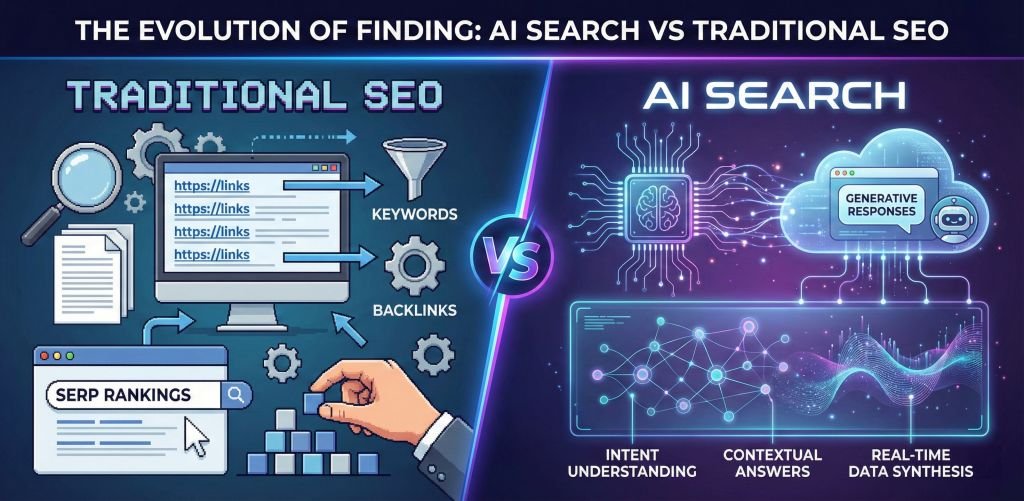
The landscape of digital marketing in the US has shifted permanently. In 2026, AI search is replacing traditional SEO not just as a buzzword, but as the fundamental infrastructure of the web.
With Google’s Search Generative Experience (SGE) and Gemini now powering over 70% of US queries, the era of “10 blue links” is effectively over. Recent data shows that zero-click searches—where users get their answer without leaving the results page—have hit an all-time high of 69% in the US when AI overviews are present.
For US business owners and SEO professionals, this is a wake-up call. The strategies that worked in 2023 (keyword stuffing, generic backlinks) are now liabilities. Today, you are optimizing for Answer Engines, not just Search Engines.
This guide covers exactly how AI search technologies are rewriting the rules and the specific AI-first SEO strategy you need to survive.
To understand the future of SEO in the USA, you must understand the fundamental shift in how engines process information.
| Feature | Traditional SEO (Pre-2024) | AI Search / SGE (2026) |
| Core Mechanism | Keyword matching | Semantic understanding and entities |
| Primary Goal | Ranking #1 for a specific term | Being cited in the AI snapshot |
| User Journey | Search → Click → Read | Search → Read answer → (maybe) click |
| Content Focus | Length and keyword density | Depth, E-E-A-T and “atomic” answers |
| Success Metric | Organic traffic | Share of voice and brand visibility |
In traditional SEO concepts, we optimized for strings of text (e.g., “best running shoes”). In AI driven SEO strategies, machines look for Entities—distinct concepts with defined relationships. Google knows that “Nike” is a Brand that sells Shoes which are used for Running.
If your content doesn’t clearly map these entity relationships using structured data for AI search, you aren’t just ranked low; you are invisible to the specialized AI models.
We are witnessing the transition from Search Engine Optimization (SEO) to Answer Engine Optimization (AEO).
In the US market, convenience is king. A 2025 survey revealed that 52% of US adults now use LLMs like ChatGPT or Gemini as their primary information source, bypassing traditional search entirely for informational queries.
Informational Search Queries (e.g., “how to fix a leaky faucet”) are being swallowed whole by AI. You will likely lose 30-50% of top-of-funnel traffic.
Commercial / Service Intent is where the battleground remains. When a user asks “best AI SEO services USA,” the AI will synthesize reviews, ratings, and authority signals to recommend a shortlist. Being on that shortlist is everything.
To thrive in the post SEO search landscape, you need a new playbook. Here is the framework for content optimization for AI search.
If you can’t beat them, join them. Your goal is to be the source the AI quotes.
The “Inverted Pyramid” Style: Start every section with a direct, concise answer (40-60 words). This is “AI bait.”
Q&A Formatting: Structure your H2s and H3s as natural language questions (e.g., “Is SEO dead in the USA?“).
AI trusts experts. You cannot rank for “shoe sales” if you haven’t proven you know everything about “shoes.”
Create topic clusters: A central “pillar page” linked to dozens of supporting articles.
Use semantic search optimization: Don’t just use synonyms. Discuss related concepts. If writing about “AI SEO,” you must discuss “LLMs,” “Neural Matching,” and “Vector Search.”
Schema Markup: It is no longer optional. Use `Article`, `FAQPage`, and `Organization` schema to feed data directly to the AI.
Fast Load Times: AI agents prioritize fast, accessible information.
As the web floods with generative AI search results, Google filters aggressively for quality. E-E-A-T signals for AI (Experience, Expertise, Authoritativeness, Trustworthiness) are your shield.
1. Experience: Use first-person language (“In our tests…”). Show photos of your team or office.
2. Expertise: Have content reviewed by qualified professionals. Author bios are critical.
3. Data-Backed Insights: Don’t just claim trends; prove them. Cite US market & trends data.
Example: “Our analysis of 500 US e-commerce sites showed a 22% drop in organic traffic for non-optimized sites in 2025.”
For the industry: E-commerce, the changes are even more drastic.
Google’s new shopping features allow users to “chat” with products. “Show me this jacket in blue, but cheaper.”
Multimodal Search Optimization: Your product images must be high-res and clearly labeled for computer vision analysis.
Structured Product Data: Ensure your `Merchant Listing` schema includes price, availability, and shipping details to appear in conversational search results.
How Google AI impacts SEO is clear: Mediocrity is being automated away.
The winners in 2026 won’t be the ones with the most backlinks or the highest keyword density. They will be the brands that build genuine entity authority, provide unique value that AI cannot replicate (like true human insight), and structure their data for the machine age.
AI search optimization is not a “tactic.” It is the new standard.
YoGrow Solutions Pvt Ltd – Your Partner in Growth.
· Website: https://yogrowsolutions.com
· Email: info@yogrowsolutions.com
· Phone: +1 (571) 408-6124
· Address: 418 BROADWAY, ALBANY, NY 12207
AEO is the process of optimizing content to provide direct, concise answers that AI models (like ChatGPT or Google SGE) can easily extract and present to users.
No, but it will replace lazy SEO professionals. The role is shifting from “keyword hacker” to “content strategist” and “technical data architect.”
Traditional rank trackers are often inaccurate for SGE. You need to focus on “Share of Model” or “Snapshot Visibility”—measuring how often your brand is cited in AI responses for your core topics.
Generic “what is” blogging is dying. However, opinionated, deeply researched, and highly specific content (e.g., case studies, data analysis) is more valuable than ever because AI needs sources to learn from.



Leave A Reply Now