



In the hyper-competitive digital marketplace of 2026, the question isn’t just “Do I need SEO?” but rather “What kind of SEO do I need?” For most business owners, the distinction between Global SEO and Local SEO can be the difference between a thriving lead pipeline and a wasted marketing budget.
Imagine you are a boutique law firm in New York. Ranking for the term “best legal advice” (a global term) might bring you traffic from London or Sydney, but it won’t put a single client in your conference room. Conversely, a SaaS company targeting the global market with the keyword “software company near me” is effectively shouting into a vacuum.
At YoGrow Solutions, we’ve seen businesses struggle to find their footing because they’ve misaligned their search strategy with their physical and digital footprint. This guide breaks down everything you need to know about the battle between global and local search, and how to choose the right path for your specific growth goals.
Global SEO is the practice of optimizing your website to rank for searches on a national or international scale. It is designed for businesses that provide products or services that aren’t tied to a specific physical location. Think of giants like Amazon, HubSpot, or digital service providers who can serve a client in Tokyo just as easily as one in Toronto.
The goal of Global SEO is to build a high level of domain authority and relevance across broad, industry-specific keywords. In 2026, this involves sophisticated Technical SEO, International SEO structures (like ccTLDs or subdirectories), and Semantic SEO to ensure search engines understand your content’s context across different languages and cultures.
International SEO Google Tags: Using `hreflang` tags to tell Google which language and region a specific page is for.
Broad Keyword Targeting: Competing for high-volume, “vanity” terms that define an entire industry.
Backlink Authority: Earning mentions from high-authority global publications and industry leaders.
Programmatic SEO: Generating thousands of high-quality pages to capture “long-tail” global queries at scale.
Local SEO is a specialized subset of search engine optimization that aims to increase your visibility in search results for people within a specific geographic area. If your business has a physical address or serves a defined territory—like a restaurant, medical clinic, or plumbing service—Local SEO is your lifeblood.
The heart of Local search SEO is the “Local Pack” or “Map Pack.” This is the block of Google Maps results that appears at the top of the search engine results page (SERP) when someone searches for terms like “plumber near me” or “coffee shop in Brooklyn.“
Google Business Profile (GBP): Optimizing your listing to ensure accuracy in the map pack.
NAP Consistency: Ensuring your Name, Address, and Phone number are identical across every directory on the web.
Local SEO Ranking Factors: Focusing on proximity, relevance, and prominence.
Google Maps SEO Services: Enhancing your map visibility through strategic optimization and review management.
Understanding the nuances between these two strategies is critical for resource allocation. Here is how they diverge in 2026:
In Global SEO, you might target “SEO tools” or “how to calculate ROI.” These are broad and extremely competitive. In contrast, Local SEO keywords are almost always geocentric. A local strategy focuses on terms like “SEO agency in New York” or “New York local citations.“
LSI Keywords play a different role here. For global searches, LSI keywords broaden the topic. For local searches, LSI keywords often include nearby landmarks, neighborhood names, and regional slang.
Global content is universal. It needs to be understood by anyone, anywhere. Local SEO requires hyper-local content. This means writing about local events, referencing local community news, and creating pages for every specific neighborhood you serve.
While Global SEO thrives on high-DR (Domain Rating) links from sites like Forbes or TechCrunch, Local SEO relies heavily on Local Citations. These are mentions of your business on local directory sites, chamber of commerce pages, and local news outlets. In local search, a link from a neighborhood blogger can be more valuable than a link from a national site because it proves your physical relevance to the area.
Technical SEO for global sites often involves managing International SEO Google hierarchies and ensuring that CDNs (Content Delivery Networks) serve the site fast across continents. Local technical SEO leans heavily into Schema Markup (specifically LocalBusiness schema) to feed search engines structured data about your location, hours, and services.
In Global SEO, you are competing with every business on the planet. In Local SEO, your competition is limited to the businesses within a 5-to-10-mile radius. While the volume of local search is lower, the conversion rates are significantly higher because the intent is more immediate.
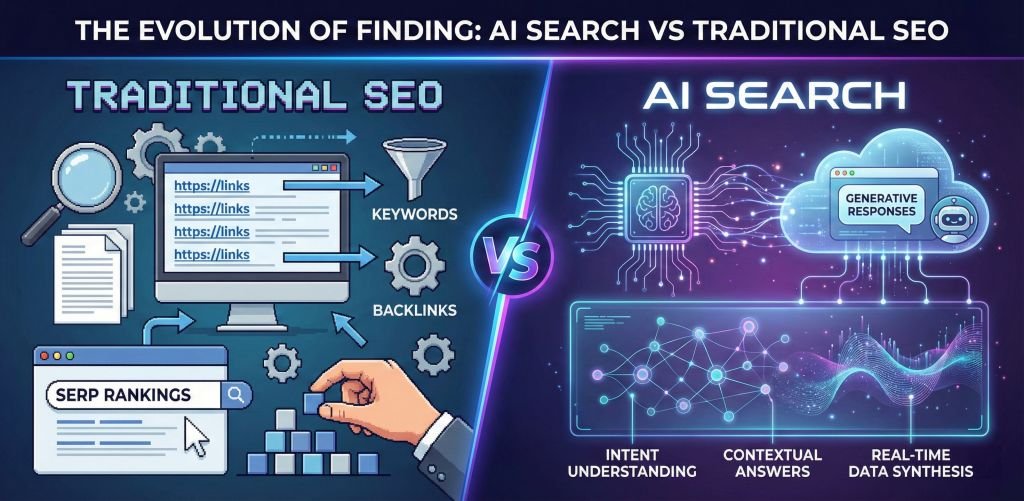
As we move through 2026, the rise of AI Overviews (formerly SGE) and Voice Search Optimization is changing how both strategies work.
AI and Local Intent: Search engines are getting better at identifying “hidden” local intent. Even if a user doesn’t type “near me,” the AI understands their location and serves local results first.
Voice Search: People use conversational language when searching via voice (“Hey Siri, find a good mechanic nearby“). This requires a bridge between technical SEO and natural language processing.
Mobile-First Indexing: Since the majority of local searches happen on-the-go, mobile speed and Core Web Vitals are now non-negotiable for both local and global players.
If you’ve determined that a local strategy is right for you, here is a quick Local SEO checklist to get you started:
1. Claim and Verify Your GBP: The most important step in Google local SEO.
2. Audit Your NAP: Fix any inconsistencies in your business name, address, or phone number.
3. Implement Local Schema: Add “LocalBusiness” structured data to your homepage and contact page.
4. Gather Reviews: High-quality, frequent reviews are a top Local SEO ranking factor.
5. Build Local Citations: Get listed on Yelp, Yellow Pages, and industry-specific directories.
6. Optimize for Mobile: Ensure your site loads in under 2 seconds.
At YoGrow Solutions, we don’t believe in a one-size-fits-all approach. We understand that many businesses actually need a Hybrid SEO Strategy.
For example, a franchise business needs Global SEO to build the brand’s national authority, but each individual franchise location needs a robust Local SEO plan to dominate its neighborhood. Our team of experts specializes in creating multi-layered campaigns that capture broad market share while maintaining a laser-focus on local conversions.
We leverage advanced data analytics to identify exactly where your customers are and how they search. Whether you need Google Maps SEO services to dominate the New York market or a heavy-hitting international campaign, YoGrow Solutions provides the data-driven expertise to make it happen.
Choosing between Global and Local SEO depends entirely on your business model.
Choose Global SEO if you sell products online, offer digital services, or have no physical presence requirements.
Choose Local SEO if you rely on foot traffic, serve a specific city, or provide home-based services in a defined territory.
The digital landscape is too vast to navigate without a map. If you’re ready to stop guessing and start growing, it’s time to consult with the experts.
Ready to dominate the search results?
Schedule a Free Audit with YoGrow Solutions today and let’s build a strategy that works for your unique goals.



Leave A Reply Now